Language is not just about learning words; it is about understanding the soul, line of thought, and aesthetic of a culture. At SME Akademi, through our personalized and boutique education approach that distances itself from rote methods, we teach Turkish in its most accurate, fluent, and natural form.
Turkish stands out as a shared communication language not only for Türkiye, but also across a broad geography. In today's world of expanding economic, cultural, and academic ties, knowing Turkish opens the door to numerous opportunities on an international level.
At SME Akademi, our curriculum is structured based on the Common European Framework of Reference for Languages (CEFR). Systematically progressing from A1 (Beginner) to C1 (Advanced) levels, this program aims to steadily develop students' listening, speaking, reading, and writing skills. Lessons proceed under a communication-based approach and structure, ensuring that students use the language effectively in daily life, academic settings, and professional environments.
Textbooks & Learning Materials
We make language learning permanent using specialized textbooks and up-to-date resources.
We build a solid foundation with original workbooks and materials tailored to each proficiency level.
Educational Videos & Digital Content
We support your learning process at any moment through subject-explanation videos and digital content.
Thanks to our pronunciation- and practice-oriented video archive, you can practice from wherever you wish.
Conversation Clubs & Social Practice
Through live conversation clubs, you can comfortably use the vocabulary you have learned in daily life.
You can confidently enhance your Turkish speaking skills with interactive speaking workshops.
About the Common European Framework of Reference for Languages (CEFR)
Language is the most fundamental tool for individuals to express themselves, construct their cultural identities, and sustain social communication. In this context, language learning and teaching is not merely a communicative skill, but also key to an individual's interaction with the world. Developed by the Council of Europe, the Common European Framework of Reference for Languages (CEFR) was created to establish a common reference system for language learning, teaching, and assessment (Council of Europe, 2001).
Published in 2001 by the Council of Europe, CEFR quickly expanded beyond European borders and gained widespread use globally (Council of Europe, 2020).
Purpose and Core Principles of CEFR
The primary objective of CEFR is to define language proficiency through a common standard, thereby building a comparable, transparent, and internationally recognized system. While standardizing language learning and teaching, this framework also aims to personalize the learning process (Council of Europe, 2001).
The language learning process does not consist solely of learning grammar rules; it encompasses communicative competence, cultural awareness, and meaning-creation processes. Adopting this understanding, CEFR approaches language from a usage-oriented perspective. Rather than focusing on what the student "knows," emphasis is placed on what they "can do." Therefore, level descriptors within the system are formulated as "can-do statements" (Council of Europe, 2020).
This approach clearly reveals what a student can achieve across the four core language skills (listening, speaking, reading, writing). Consequently, learning goals become clear for teachers, students, and institutions, making evaluation processes more transparent and measurable (Cambridge Assessment English, n.d.).
Structure and Levels of CEFR
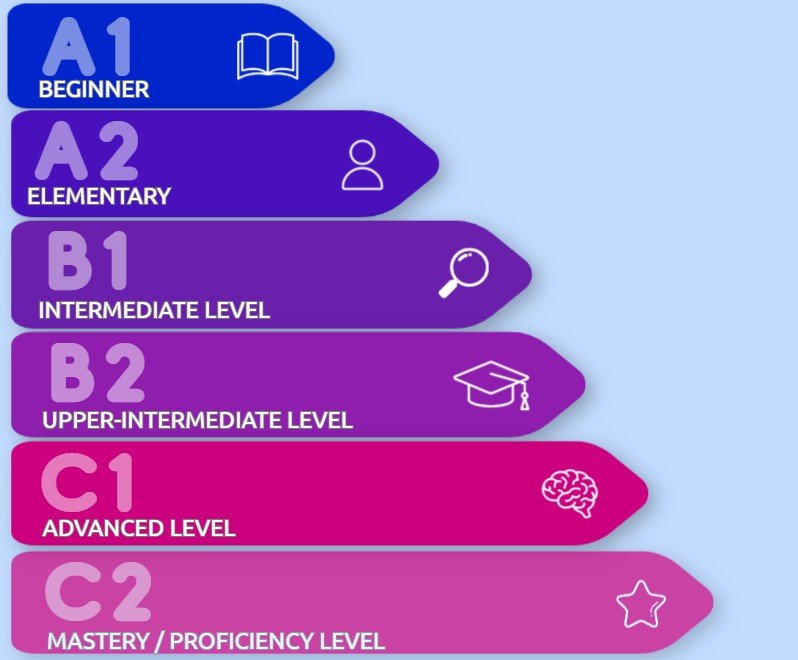
CEFR defines language proficiency across six main levels: A1, A2, B1, B2, C1, and C2. Each level represents a specific domain of linguistic competence. These levels rely on descriptive statements prepared to demonstrate how effectively a student can use the language (Council of Europe, 2001).
A Levels: Basic User
A1 (Beginner): The student can understand everyday expressions and basic phrases; can introduce themselves and others simply; can interact if the other person speaks slowly and clearly.
A2 (Elementary): The student can communicate in simple sentences regarding frequently encountered topics (shopping, family, work, etc.); can understand short texts; can express their needs in simple terms (British Council, n.d.).
B Levels: Independent User
B1 (Intermediate): The student can understand situations frequently encountered in daily life; can describe experiences and plans; can produce simple and clear texts.
B2 (Upper-Intermediate): The student can understand complex texts, including abstract topics; can express ideas clearly and in detail; can communicate comfortably with native speakers (Council of Europe, 2001).
C Levels: Proficient User
C1 (Advanced): The student can understand long and challenging texts; can use the language fluently and flexibly in academic, professional, and social environments; can convey thoughts clearly.
C2 (Mastery): The student possesses language mastery nearly equal to a native speaker; can distinguish fine nuances of meaning; can communicate accurately and effectively even on complex topics (Cambridge Assessment English, n.d.).
This level system is designed in accordance with the gradual nature of language learning. As students progress from A1 to C2, they learn not only the rules of the language, but also its cultural and communicative context (Council of Europe, 2020).
CEFR Approach
While CEFR divides language learning into four main skills (reading, writing, listening, speaking), it places great emphasis on establishing a balance among these skills. Specifically, the concept of communicative competence lies at the center of CEFR (Council of Europe, 2001).
1. Listening
Listening skill encompasses the student's ability to understand speech at different speeds and accents. Different goals are defined for each level. For example, while short and slow speech is understood at the A1 level, it is possible to comprehend abstract, fast, and complex speech at the C1 level.
2. Reading
Reading skill requires a depth of understanding that varies according to text types. While short, simple texts can be read at the A2 level, literary, academic, or technical texts can be fully understood at the C2 level (Council of Europe, 2020).
3. Speaking
Speaking skill is divided into two areas: production and interaction. CEFR evaluates not only the student's ability to produce speech, but also their participation in mutual communication. In this respect, it adopts a student-centered and interaction-focused approach (Council of Europe, 2001).
4. Writing
Writing skill covers the student's ability to convey their thoughts clearly, coherently, and in a grammatically correct manner. CEFR emphasizes that the writing process is not just text production, but also the ability to construct and convey meaning (Cambridge Assessment English, n.d.).
Lifelong Learning
The fundamental philosophy of CEFR rests on the idea that language learning is a lifelong process. This approach encourages the individual's active participation in the learning process and monitoring of their own development (Council of Europe, 2020).
Furthermore, CEFR supports plurilingualism. Knowing multiple languages at varying levels by an individual is considered natural. This is referred to as "plurilingual competence" and encourages the individual to switch between different languages (Council of Europe, 2001).
Images to be added
You can add images between paragraphs.
Make sure there is a staircase visual at the bottom.
Visual plan ranging from A1 to C2
Turkish for Foreigners: A1-C2 Course and Level Ladder Plan
The 6-step structure progressing from bottom to top (from absolute zero to peak fluency):